SINGLE GENE DEFECTS
First described by Mendel in 1866 these are defects determined by changes or mutations of single genes. Genes may be the strong dominant ones or the weak recessive ones.
DEFINITIONS
GENE : A hereditary factor that interacts with the environment to determine a trait.
LOCUS : The physical location of a gene on a chromosome. Since chromosomes are paired there are two alleles at a single locus.
ALLELES : The alternative forms of both normal or abnormal genes, for a particular trait, that occupy corresponding loci in a pair of homologous chromosomes.
GENOTYPE : The allele make up or the genetic constitution at a locus.
PHENOTYPE : It describes the end result of both the genetic and environmental factors which produces the clinical picture or the observed expression of the gene.
HOMOZYGOUS : Describes the condition of having identical alleles at one locus, which can be either normal or abnormal.
HETEROZYGOUS: Describes the condition of having two different alleles at one locus, usually one normal and the other mutant. In autosomal recessive and X- linked recessive conditions, such individuals are referred to as carriers.
DOMINANT : In such a condition the abnormality manifests in both the heterozygous as well as in the homozygous state. Homozygous being the more severely affected state.
RECESSIVE : Such conditions manifest only in the homozygous state.
AUTOSOMAL : Refers to genes on the 22 pairs of non-sex chromosomes.
X- or Y- LINKED: Refers to genes having loci on the X or Y chromosomes. With X- linked, both recessive and dominant inheritance are seen.
PEDIGREES : They are graphic representations of a family tree which show the biological relationship of the index case, or proband or propositus to the rest of the individuals. Fig. 25. Symbols are used to illustrate the various states and relationships of the family tree. Fig. 26.
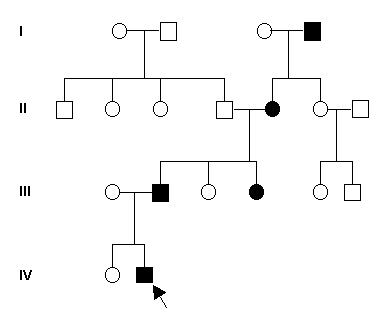
Fig 25

Fig 26