AUTOSOMAL DOMINANT
Over 50% of the presently described traits are dominant, while nearly 30% are recessive and only 10% are X-linked. Fig. 27, shows the pattern of inheritance.
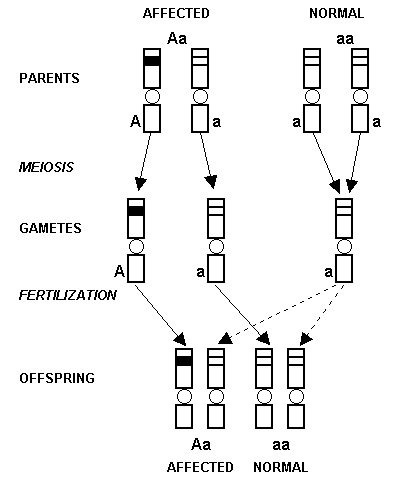
Fig 27
CRITERIA
- Transmission of the trait continues from generation to generation without skipping. Fig. 28.
- Except for a new mutation, every affected child has an affected parent.
- In the mating of an affected heterozygote to a normal homozygote, the risk of an affected birth for each pregnancy is 50%.
- The two sexes are affected in equal numbers.

Fig 28
SPECIAL FEATURES
- New mutations
Seen as isolated cases. Increased paternal age may be associated with new mutations. Majority of Achondroplasics are new mutations. - Reduced penetrance
It is a clinical term which is an expression of the number of individuals who have the gene and show the trait. It is an all or nothing phenomenon and if the frequency is less than 100%, reduced penetrance exists. - Variable expressivity
It refers to the degree of expression of a trait. The individuals in a family may show mild to moderate to severe forms of the disease and need to be examined carefully in order not to miss the diagnosis.
Multiple Neurofibromatosis and Marfan syndrome are good examples of reduced penetrance and variable expressivity. - Variation in age onset
Adult polycystic kidney disease although inherited as a dominant trait shows cysts only later in life. Huntington's disease is another example of an adult onset disorder where clinical features manifest in the third and fourth decades of life. - Variation in severity dependent on sex
In Huntington's disease the disease manifests earlier, if the affected parent is the father. - Phenocopy
It is an environmentally caused phenotype which resembles one produced by a mutant gene. Warfarin induced embryonic defects resembling Conradi's syndrome is such an example. - Genetic heterogeneity
Here a similar clinical picture may be produced by different mutations at the same locus or at different loci. Retinitis pigmentosa may be caused by both autosomal dominant or recessive inheritance.
CLINICAL EXAMPLES
- Huntington's disease is an autosomal dominant, adult onset disease. The clinical features include progressive loss of mental activity, mood disturbances and choreiform movements. The onset is usually in the 4th decade and DNA technology has crudely located the gene to the short arm of chromosome 4 (4p).
- (b) Marfan syndrome is also an autosomal dominant disorder which shows variable expression like multiple neurofibromatosis. It is a disorder of connective tissue which leads to features such as abnormal body proportions, arachnodactyly, mitral or aortic valve defects and lens dislocations. It involves more than one system. A tentative gene location on the long arm of chromosome 15 (15q) has been made.
- Familial hypercholesterolaemia is a condition following the deletion of the gene producing LDL (low density lipoprotein) receptors. This leads to increased serum cholesterol and premature coronary artery disease.