MEIOSIS
In this type of division, diploid gametic precursors produce haploid gametes each with 23 or the haploid number of chromosomes. This is seen in spermatogenesis and in oogenesis. Meiosis is preceded by one round of DNA synthesis and is followed by two special cell divisions. Fig. 20.
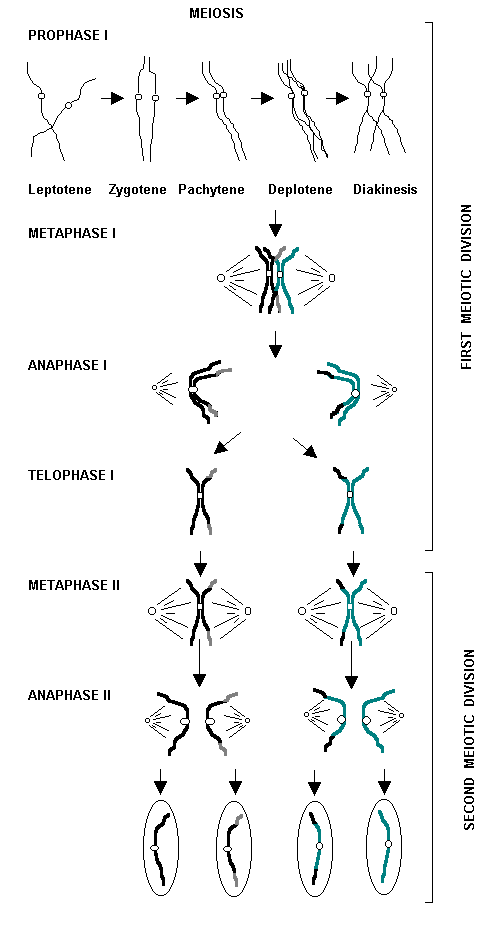
Fig 20
The first division is referred to as meiosis I which is a reduction division. Meiosis I is made up of the four stages prophase I, metaphase I, anaphase I and telophase I, of which prophase I is divided into several sequential stages.
At the commencement, the diploid cell with its completed DNA replication and 46 chromosomes, each with its sister chromatids enters prophase I. The first substage is called leptotene, when the chromosomes first become visible as threads, with the chromatids unable to be distinguished. Zygotene follows where the homologous chromosomes (paternal and maternal ones ) pair off along their lengths side by side. The synaptonemal complexes now appear which will assist in the synapsis and crossing over of chromosomal material. In the next substage of pachytene, the chromosomes condense further, the chromatids (four) are visible forming tetrads and recombination takes place between homologous chromosomes through crossing over. It is here that paternal and maternal recombination of DNA occurs to produce the wide variations seen in humans. In the diplotene stage, the homologous chromosomes begin to separate but are held together at the points of crossing over like crosses, referred to chiasmata. In diakinesis which follows, the chromosomes reach maximal condensation.
In metaphase I, the nuclear membrane disappears, and the attached homologous pairs of chromosomes move to the equator of the formed spindle. In anaphase I, the attached whole chromosomes separate from each other and move to the opposite poles of the cell. The chromatids remain attached to each other and DO NOT separate. In the migration of the chromosomes to the opposite poles, the selection as to which pole to migrate is random, so that each pole will have a mixture of paternal and maternal chromosomes. During the stage of telophase I, the two haploid sets reach each pole and the cytoplasm divides.
Meiosis II follows after a brief interphase with no DNA synthesis. This division is similar to mitosis and has the same stages, except that here there are two cells, each with only 23 chromosomes. Each of these will produce two more cells having 23 chromosomes per cell, a total of four haploid cells.
The process of meiosis differs in males and females. Fig 21. In males it is a continuous process which begins in the mature seminiferous tubules of adolescents, and results in the production of millions of spermatozoa. In females, meiosis begins in the ovary of the developing female foetus and by birth the process is arrested in prophase I, in a stage referred to as dictyotene. After the female baby is born and attains menarche, with each ovulation meiosis I is completed. and Meiosis II begins. This is completed only following the entry of the spermatozoon into the egg. In meiosis I, Iry oocytes and spermatocytes divide to form their secondary forms, while in meiosis II the IIry oocyte gives rise to the ovum and the IIry spermatocyte to the spermatids. These spermatids mature into spermatozoa.

Fig 21
This arrested form of oogenesis is of clinical significance. A female baby from the time of birth or earlier, has in her ovary all the ova she would need for her reproductive life. This means that throughout her life, a woman and the pool of ova she carries would be exposed to all forms of environmental hazards like drugs, medications, infections, radiation and any other harmful chemicals. This can lead to a higher risk of mutations or undesirable gene changes in females. It also highlights the fact that older the woman at the time of fertilization, the older will be the ova and chromosomes she carries. This could lead to sluggish movement of chromosomes and nondisjunction at cell division, an accepted basis for the association of late maternal age and nondisjunction, as seen in conditions like Down syndrome (trisomy 21).
In males however, spermatogenesis begins at sexual maturity and it is a continuous process throughout the reproductive life of the male. It produces fresh supplies of spermatozoa and therefore less likely to sustain permanent and cumulative or accumulating damage.
Meiosis differs from Mitosis for the following reasons :
- It occurs only in germ cells, where as mitosis occurs in somatic cells.
- It consists of two sequential cell divisions, whereas mitosis has only one.
- Pairing of homologous chromosomes occurs, which is not seen in mitosis.
- Recombination of homologous chromosomes take place, which is not seen in mitosis.
- There is a reduction in the number of chromosomes from 46 to 23, unlike in mitosis.
The genetic consequences of meiosis are:
- It helps in the reduction of the number of chromosomes, and thereby assists gamete formation.
- It helps in the segregation of alleles, thereby allowing only one of an original gene pair to be included in each gamete.
- It assists in the independent assortment of homologous chromosomes, so that each gamete contains a mixture of paternal and maternal chromosomes.
- By the process of crossing over, it ensures that each gamete carries genes inherited from both the father and the mother.