MITOSIS
In any tissue where cells divide to replenish lost ones, like for example in the skin, the new cells produced from the parent cell need to have its diploid number of 46 chromosomes. The process continues indefinitely maintaining the number at 46. This type of cell division is called mitosis. Mitosis is seen in somatic cells and also in the early development of germ cells where a large number of cells are required. The position of mitosis in a cell cycle is shown in Fig. 18. The cell cycle begins with a phase G1 which follows mitosis(M). During G1 the DNA remains in an unreplicated state. DNA synthesis or the S phase follows G1. Here the DNA shows semiconservative replication, and each single strand doubles to form two chromatids. The phase G2 follows the S phase, at the end of which mitosis begins and completes to enter G1 again. The period beginning with G1 and ending with G2 is referred to as the stage of interphase, when the cell is not dividing.
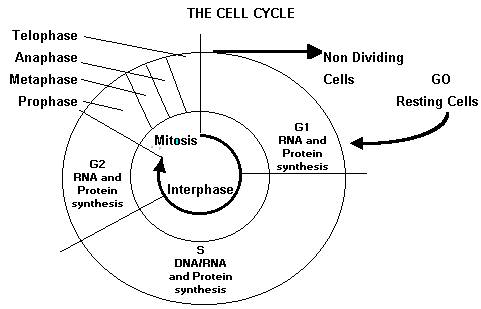
Fig 18
Although mitosis is a continuous process, for convenience it can be divided into four stages. Fig. 19. The interphase cell entering mitosis begins with prophase when the chromosomes separate, condense and become visible. The two parallel strands the sister chromatids attached to each other by the centromere, become visible and the nuclear membrane disappears (prometaphase). The centrioles separate and move to the opposite poles and begin to form a mitotic spindle. In the next stage of metaphase the chromosomes move towards the equator of the cell and arrange themselves on the completed spindle. In anaphase each chromosome splits lengthwise into the two chromatids which now begin to move away from each other along the spindle fibres towards the poles of the cell, a process called disjunction. This is assisted by a structure called the kinetochore which is disc shaped and attaches the centromere of each chromosome to the spindle fibres. In the final stage of telophase, the daughter chromosomes reach the two poles, decondense, and form the nuclear membranes.
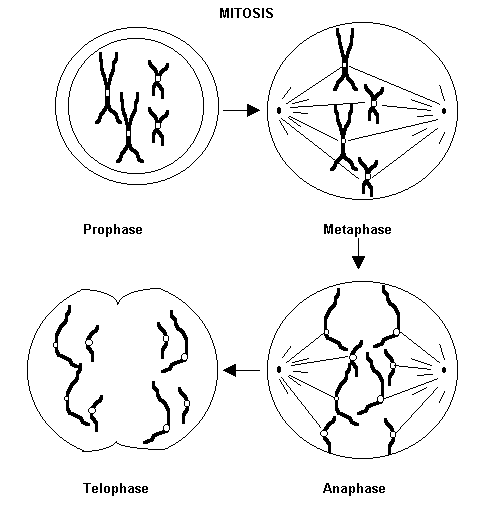
Fig 19
The cytoplasm of the parent cell now divides (cytokinesis) and distributes itself around each of the two newly formed nuclei and the two new cells enter the stage of interphase (G1 phase).